CHOOSE YOUR NIGHTFALL SAFARI
ABOUT US
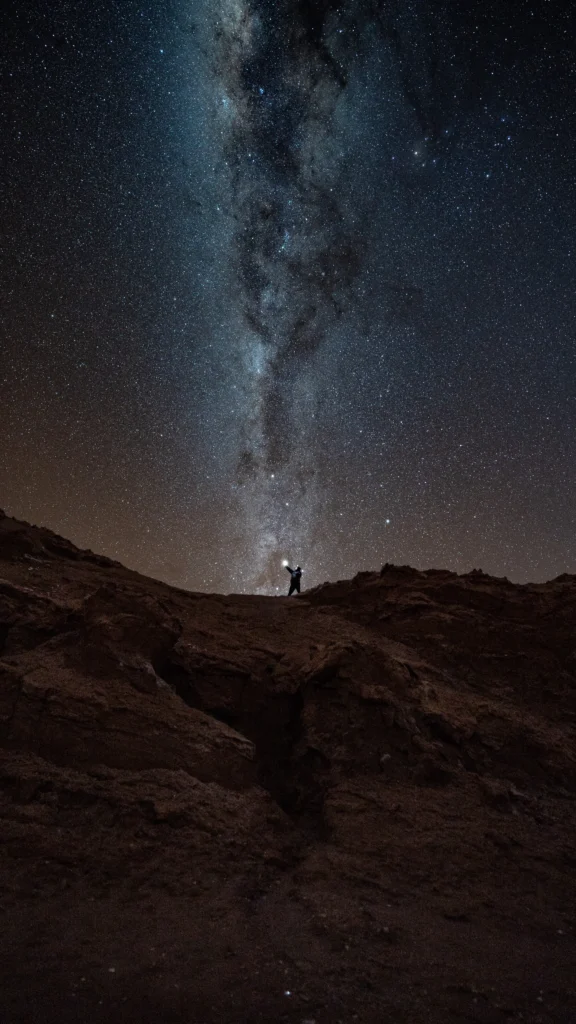
The desert as a natural observatory.
Nightfall Safari is an invitation to discover the desert and the sky at the same time. We are nomadic by design: the observatory arrives at dusk, leaving only you and the clearest skies on Earth, and nothing behind but your best memories. Our professional team makes the experience as safe and comfortable as possible, far from light pollution, for a totally immersive experience under the stars.
SPECIAL CONSIDERATIONS
INTERESTING READS
What Bortle 1 Actually Means
The scale John Bortle published in Sky & Telescope in 2001, explained class by class — from the Class 9 sky of a city center to Class 1, where the Milky Way casts shadows and the zodiacal lights is so bright it gets in the way. With the measurements we take at our own sites.
Why the World’s Telescopes Came Here
The great observatories didn’t choose the Atacama for the scenary. They chose it for precipitable water vapor, the number of clear nights, atmospheric stability and altitude. This article explains each factor in plain language and ends with the obvious question: if those criteria are good enough for a billion-dollar telescope, they’re good enough for choosing where to spend a night.
NASA Researches Mars in the Desert
The ARADS project (Atacama Rover Astrobiology Drilling Studies) brought rovers and drills to the Atacama to rehearse the search for life on Mars, because the hyperarid soil here is the closest analog on Earth to Martian soil. They article tells what they were looking for, what they found, and why this ground looks so much like another planet’s.
What ALMA Is Listening To
A little over an hour from where our nights take place, sixty-six antennas at 5,000 meters listen to wavelenghts no eye can see, watching stars and planets being born. What it does, why it sits exactly there, and what it has seen.
BEGIN YOUR JOURNEY TO THE STARS
We are ready to design your private desert experience. Contact us directly to check availability and discuss personalized details.
Our visual gallery. Discover the magic of Atacama and the quality of our photo sessions.
Book your journey to the stars now. Check availability and customize your unforgettable expedition with us.
Fully personalized service. Contact us for corporate proposals or special group requirements.