


Interesting Reads
Four pieces of published science about the sky and the desert we work in, each summarisedand followed by its source.
Read 4
What ALMA Is Listening To
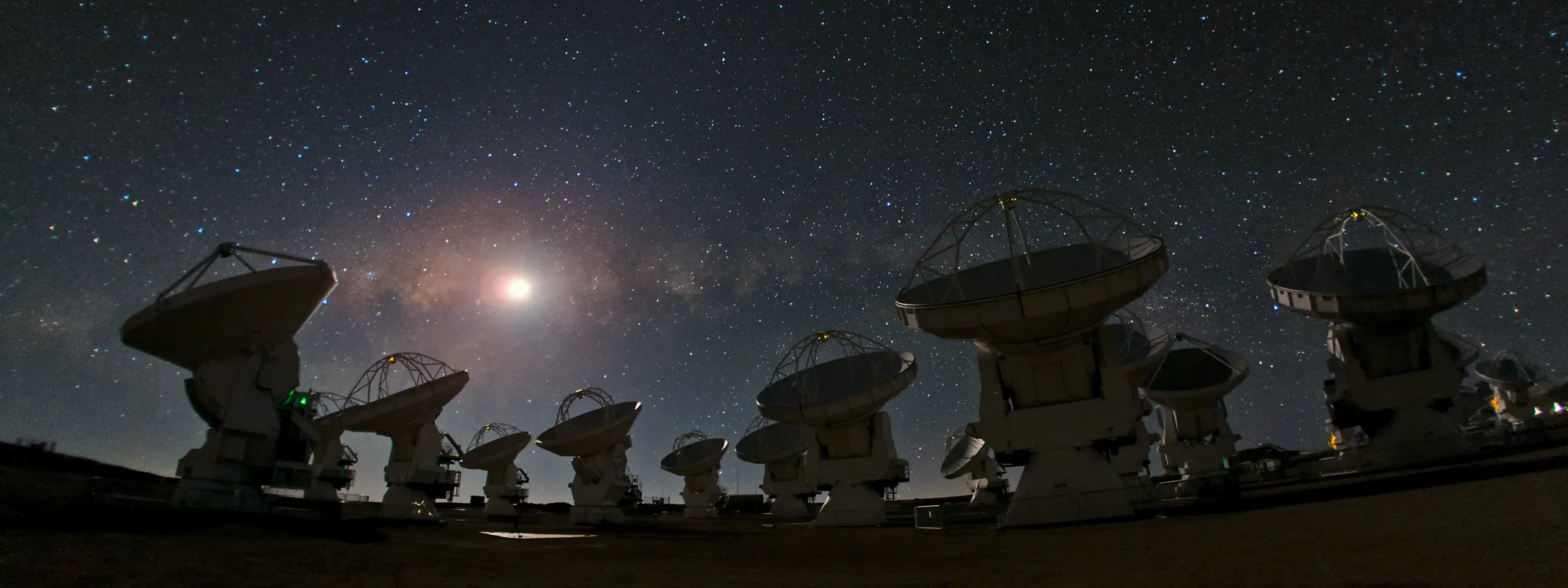
ALMA, the array of antennas on the Chajnantor plateau, does not look for the light of new planets. It follows the gas around them. In April 2025 an international team published the first results of exoALMA, a survey of 15 young star systems, each still wrapped in the disk of gas and dust from which its planets form.
A planet growing inside such a disk is too faint and too deeply buried to see directly, so exoALMA looks for what it does to its surroundings. A young planet carves gaps, raises rings and spirals, and disturbs the orderly rotation of the gas. By tracing three molecules at once, the team mapped those motions at a resolution of about 14 astronomical units with a velocity resolution of 26 metres per second.
The disks turned out to be far more structured than expected. The gas itself shows gaps, rings and spiral patterns, along with subtle departures from the smooth rotation a disk should have. Those shifts point to changes in pressure that gather dust grains into the rings where planets are built.
The first 17 papers appeared in The Astrophysical Journal Letters, with more to follow. The programme is led by researchers from MIT, the Max Planck Institute for Astronomy, the University of Milan, the National Astronomical Observatory of Japan and Université Grenoble Alpes.
SOURCE
ALMA Observatory, “exoALMA Survey Reveals Incredible Images of Structures in Protoplanetary Disks,” press release, 28 April 2025. https://www.almaobservatory.org/en/press-releases/exoalma-survey-reveals-incredible-images-of-structures-in-protoplanetary-disks/