


Interesting Reads
Four pieces of published science about the sky and the desert we work in, each summarisedand followed by its source.
Read 1
What Bortle 1 Actually Means
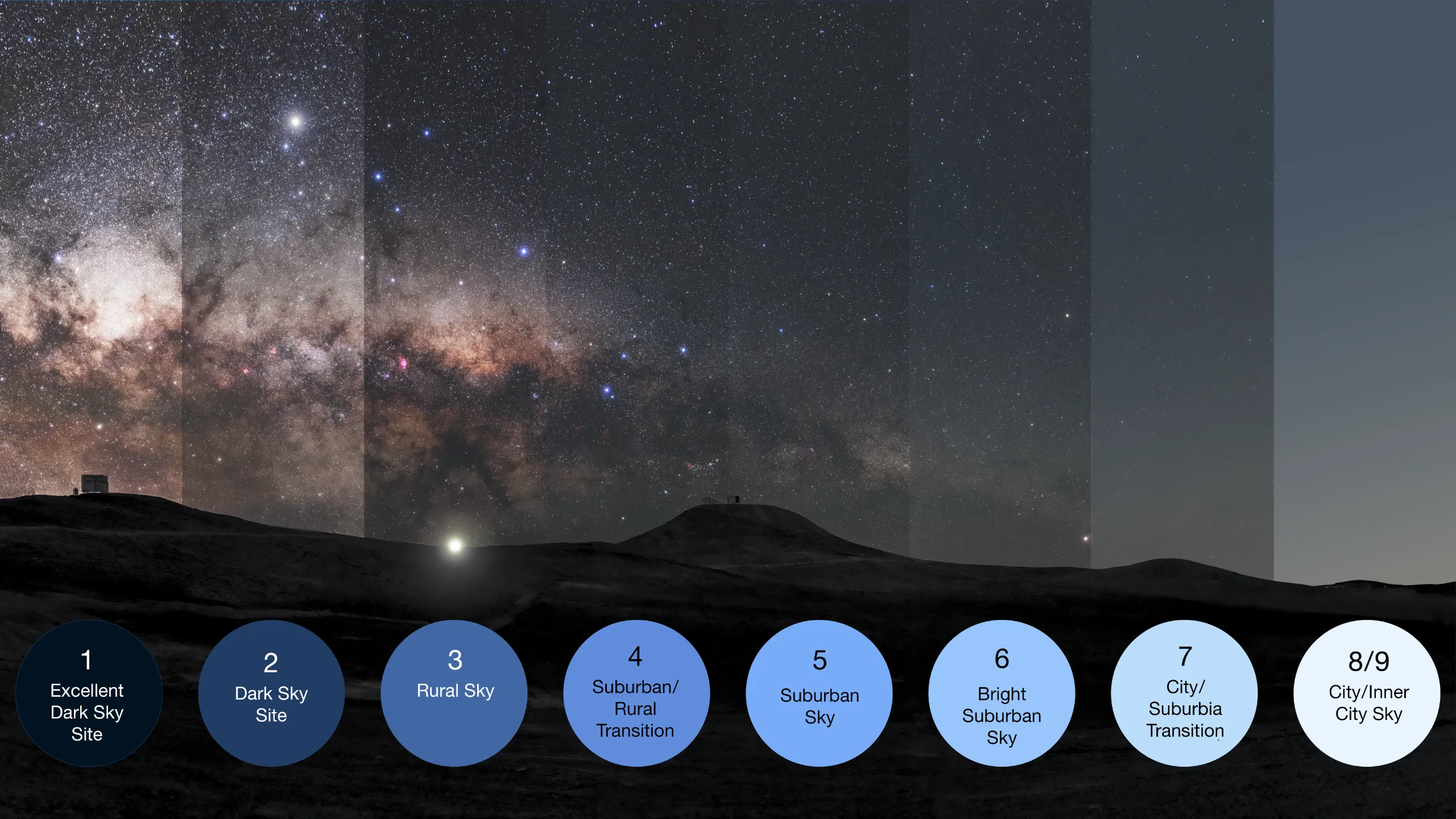
In February 2001, veteran observer John E. Bortle published a nine-step scale in Sky & Telescope to answer a simple question: how dark is this sky, really? After nearly fifty years at the eyepiece, he had seen that the usual yardstick, the faintest star visible to the naked eye, was unreliable. It depends on each person’s eyesight and effort, and it says little about faint, diffuse objects such as nebulae and galaxies, which suffer from light pollution far more than stars do.
His scale describes what an observer can actually see. Class 9 is the inner city, where stars fainter than magnitude 4 are lost and little beyond the Moon, the planets and the brightest clusters remains. Class 1, the excellent dark-sky site, sits at the other end. The naked eye reaches magnitude 7.6 to 8.0. The zodiacal light, the gegenschein and the zodiacal band are all visible. The galaxy M33 is an obvious naked-eye object, the Milky Way casts diffuse shadows on the ground, and Jupiter or Venus is bright enough to spoil dark adaptation. Your telescope, your companions and your vehicle are almost invisible.
Bortle also warned that such skies were vanishing. Many observers call a site dark when its faintest naked-eye stars are only magnitude 6.0 to 6.3, which is moderate at best. Thirty years earlier a truly dark sky lay within an hour’s drive of most cities. By 2001 it often meant travelling 150 miles or more.
SOURCE
John E. Bortle, “Gauging Light Pollution: The Bortle Dark-Sky Scale,” Sky & Telescope, February 2001. https://skyandtelescope.org/astronomy-resources/light-pollution-and-astronomy-the-bortle-dark-sky-scale/